

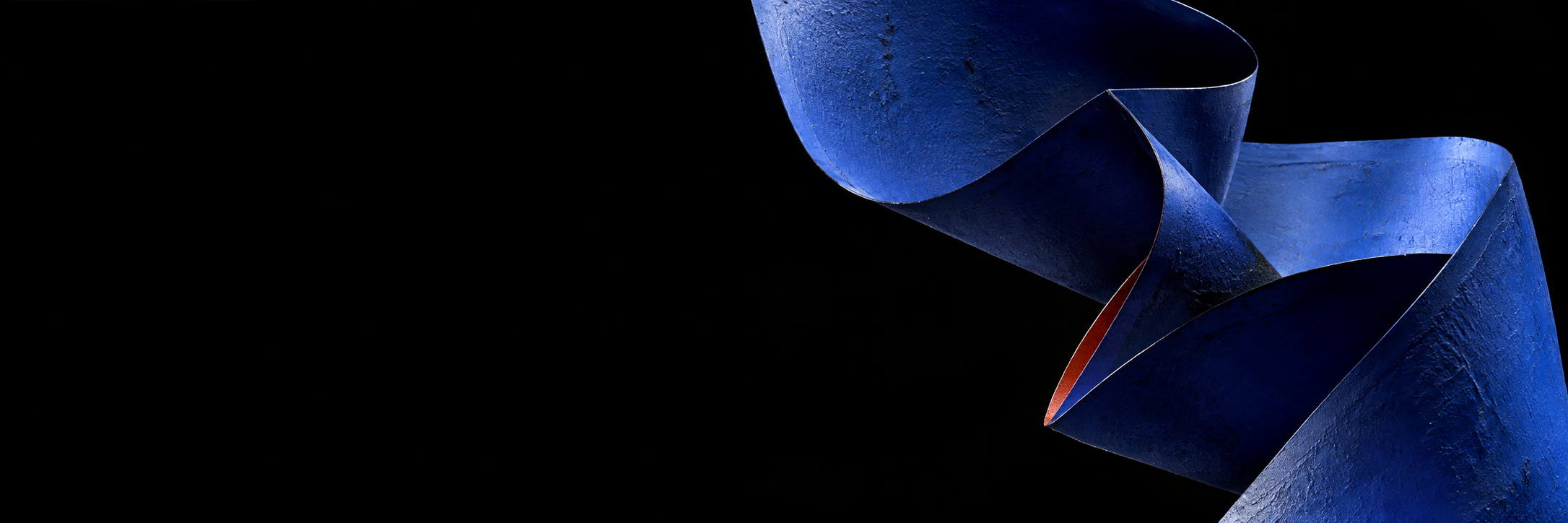
A fold is an interruption. It takes an uninterrupted surface and gives it direction: toward us, away from us, briefly out of sight. In this image, that small act becomes the entire subject.
Blue occupies most of the frame, but it does not behave as a single color. Where the form faces the light, it appears almost powdery. Where it turns inward, it deepens toward black. A narrow red edge interrupts that continuity. We notice it because it refuses to dominate.
Beauty can begin with the part we almost missed.
We are interested in this tension between generosity and restraint. A work can offer richness without showing everything at once. It can leave a passage unresolved, a surface partly concealed, a question open. That space is where the viewer enters.
This is also a useful way to think about a room. A room does not need every object to speak at the same volume. A quiet plane can make a particular shape more expressive; a dark interval can let a small reflection matter. Attention is composed through relationships.
The image here is an AI-assisted NOBLE study, not a photograph of a physical sculpture. We do not claim a material, fabrication process or artist provenance that it does not possess. Its purpose is exploratory: to test how color, apparent texture and a turn of form can hold our attention.
This is where our next chapter begins. We will make original work and examine its choices closely. We will seek conversations with the people who shape our world, and build stories with something of our own to say. The measure is not how much we collect, but how carefully we look—and what we make from that attention.
Concept and editorial direction: NOBLE with AUREUX. Text developed with AI assistance. Visual: original AI-generated NOBLE concept. Identity: Caselli source artwork, with a NOBLE optical-spacing refinement. No physical artwork is offered for sale.